
Challenges In Approaches

There are an estimated 13.4 million Christian workers representing only 0.14% of the world’s population.
People who are known as “those who never heard the Gospel” are shifting to “those who oppose or are indifferent” to the gospel. And the traditional cross-cultural methods face stiff resistance.
The Gospel is love; love does not exist in information but in relationship. In this fast-paced, information-driven age, Christians are
comfortable sharing gospel information over developing influential relationships.


Almost all outreach initiatives are focused on serving the poor and marginalized. And those in place of influence, such as professionals, business leaders, and decision-makers, remain largely neglected.
Most Christians believe the reason for the decline of Christianity is the decline of institutional trust, secularization, and the alignment of religion and politics. One major reason, above all these, is that the individual Christians did not take responsibility.

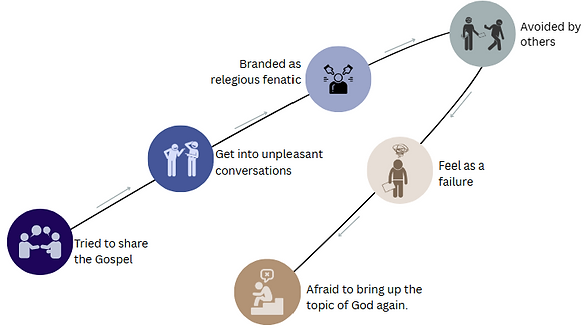
Most devoted Christians want their family members, friends, neighbors, and coworkers to believe in Jesus Christ. They long to share the gospel; however, many have tried and failed and are afraid to try again. As a result, they become hesitant, even fearful, to bring up the topic of God again. Their hearts yearn for others to know the truth, but they do not know how.
Citation
-
Rebacca Denova, “The Religious Background of Constantine” , “Constantine’s Conversion to Christianity”, May 10, 2021, https://www.worldhistory.org/article/1737/constantines-conversion-to-christianity/#:~:text=The%20Edict%20of%20Milan%20now,for%20some%20of%20his%20beliefs.