.png)

Christianity is declining!
Each year, thousands of people come to the Christian faith. At the same time, the number of those leaving the faith is also increasing. In addition, opposition to Christianity and skepticism toward its beliefs continue to grow.
The Declining Christianity
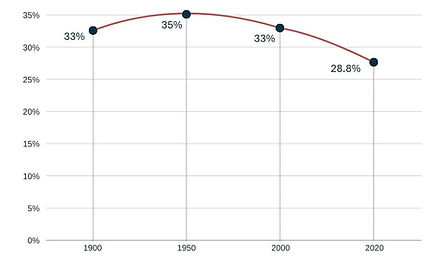
In 1900, the world population was approximately 1.65 billion, and Christians numbered 558 million, accounting for 33% of the global population. Over the following years, the population grew exponentially. By 2020, it had surpassed 7.8 billion, with Christians accounting for 2.26 billion, or 28.8%. Although the number of Christians is growing, the overall growth rate has declined significantly.
.jpg)

Between 2010 and 2020, the religious growth rate indicates that the unaffiliated and Islam are on the rise, and the Christian growth rate is on the decline. Most unaffiliated people are those leaving the Christian faith. Globally, for every one person who becomes a Christian, about 3.1 people leave the faith. According to the Pew Research Center, if current trends hold, Christianity may no longer be the world's largest religion within the next 50 years.
The Changing Attitude
We always hear that there are many people who are hungry and “open to hear the gospel. "That was true, but the reality now is that the world is largely no longer open to the gospel. People are increasingly becoming "skeptical about Jesus Christ, hostile towards Christianity, and opposed to evangelistic efforts.”
During the 1950s and 1960s, missionaries were welcomed in many nations. Revival meetings and public gospel proclamation were widely accepted. Churches and mission organizations served as beacons of God’s hope. Today, they face stiff resistance, persecution is widespread, and there are laws in place in many countries that make it harder for people to become Christians.
.jpg)
Missing 360° Approach

The mission focus must reach all sections of society: leaders, peers, and the poor—a 360° approach. But over decades, Christian outreach efforts, whether by churches, organizations, or individuals, tend to be downward-focused. It primarily focuses on providing food, clothing, shelter, healthcare, basic education, and other essential needs. They have neglected or done very little to reach influential members of society, such as educators, scientists, scholars, business leaders, professionals, policymakers, and politicians. This has increased the number of people who do not believe in God across education, business, bureaucracy, and politics. They deliberately attempt to push God out of the system.
Sources
-
Who Owns Global Christianity? https://www.gordonconwell.edu/blog/who-owns-global-christianity/
-
Annual Table of World Religions, 1900-2025 https://gmrcenter.org/wp-content/uploads/2024/02/Status-of-Global-Christianity-2024-1.pdf
-
Jews, Christians, Muslims and Atheists in 1900 and 2000 Globally, in Europe and in North America https://www.wnrf.org/cms/statuswr.shtml
-
Status of Global Christianity, 2025, in the Context of 1900–2050 https://www.gordonconwell.edu/wp-content/uploads/sites/13/2025/01/Status-of-Global-Christianity-2025.pdf
-
World Population by Year https://www.worldometers.info/world-population/world-population-by-year/
-
How the Global Religious Landscape Changed From 2010 to 2020 https://www.pewresearch.org/religion/2025/06/09/christian-population-change/